

Cable Cleats, Clamps & Hangers

Cable Cleats, Cable Clamps & Cable Hangers | Fast International Delivery |Yokelink
Cable Cleats
We are distributors of the most extensive range of Cable Cleats, Clamps & Hangers in the China, stocking market-leading products from international manufacturers, such as Ellis Patents, Prysmian, BAND-IT, and CableSafe.
Expertly designed to fix, clamp, strap and support cables – YOKELINK supply Electrical Cable Cleats which provide effective short circuit protection, support and retention to LV, MV and HV power cable systems when installed at intervals to circuits to secure electrical installations.
The Cable Cleats provide restraint and prevent excessive cable movement resultant from fault-current magnetic forces – cleats must be suitably rated for cable size (outside diameter) and anticipated fault current (peak fault level kA).
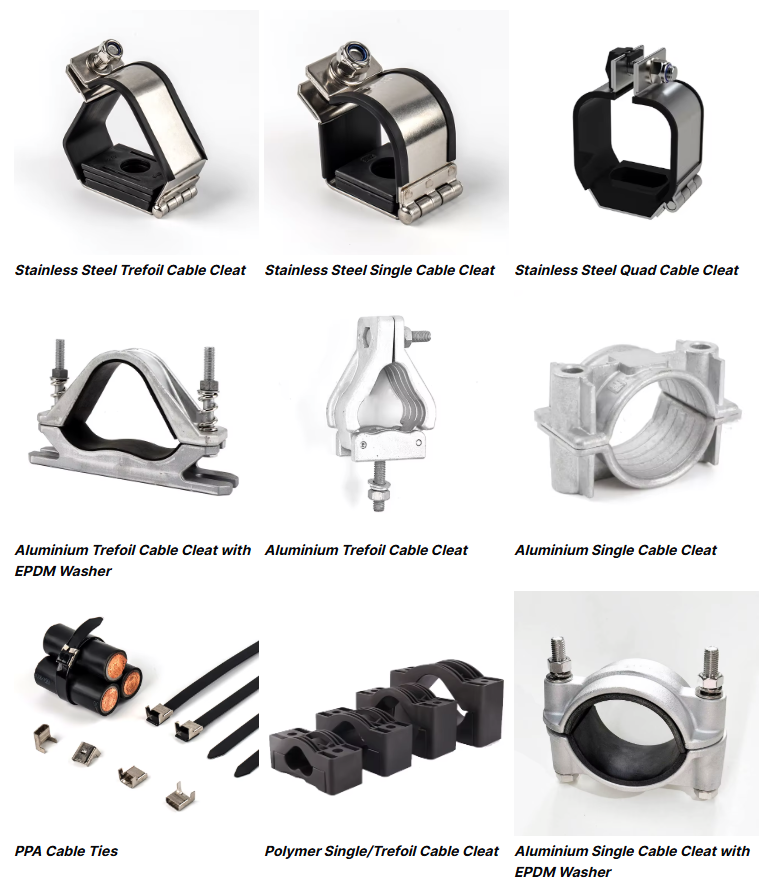
We stock Cable Cleats suitable for many applications, such as Stainless Steel, Aluminium, Single Bolt, Trefoil and Quadrafoil cleats. Continue reading or contact our experts – we’ll create a bespoke solution for your operations:
Cable Cleats & Clamps for Flat, Trefoil & Quadrafoil Cables
Three-phase installations using single-core cables are usually arranged as flat spaced, flat touching, or trefoil. BS7671 Wiring Regulations outline current ratings, voltage drops, and grouping factors for these configurations.
Single Cleat ➡
Used to restrain and secure individual low, medium, or high voltage cables, these cleats are ideal for flat or spaced arrangements. Common in substations and control panels where single-core or multicore cables are installed.
Trefoil Cleat ➡
Designed for three single-core cables laid in a trefoil (triangular) formation. Trefoil cleats are vital in power distribution systems to control magnetic forces during faults. They’re typically used in high-current circuits or where space is limited.
With Liners: Prevents damage from thermal expansion at elevated temperatures (up to 250°C during faults).
Without Liners: Used in lower-stress applications or where the cable jacket is more resilient.
Quadrafoil Cleat ➡
Specialised cleats used for four single-core cables laid in a quad formation. Common in high-power or parallel circuit applications. Cleating quadrafoil cables improves current balancing and electromagnetic performance.
Stackable & No-Bolt Cleat ➡
Stackable cleats allow multiple cleats to be mounted vertically, maximising space in cable ladders or risers. Boltless cleats are fast and tool-free to install — ideal for panel boards, data centres, and confined space environments.
Fire Resistant Cleat & LSZH Cleat ➡
Designed for applications where fire performance is critical. These cleats are made from low smoke zero halogen materials or stainless steel to maintain cable support under extreme heat, flame, or fire exposure.
Typical uses:
- Tunnel installations
- Transport infrastructure (Network Rail, London Underground)
- Oil & gas facilities
- Emergency systems (life safety cables)
- Stainless Steel Cleat ➡
High-strength, corrosion-resistant cleats used in harsh industrial environments or for cables with high short circuit levels. Stainless steel cleats are also used in marine and offshore installations for their durability and reliability.
Triplex Cleat ➡
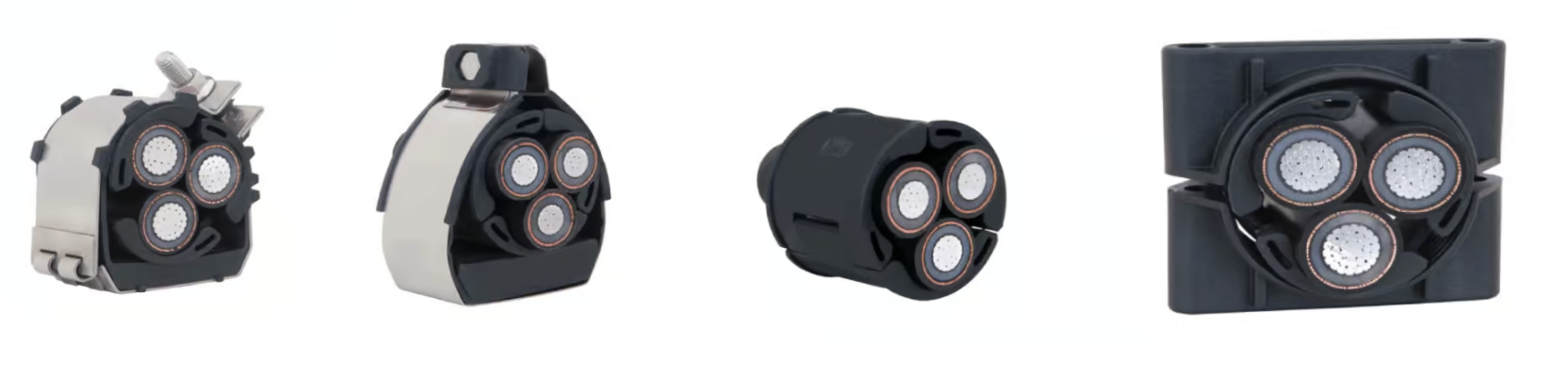
Triplex cables are three single-core cables twisted together, commonly used in 11kV to 33kV MV HV installations. Due to their spiral shape, standard cleats often can’t securely hold them. To solve this, Triplex cable surrounds are applied to form a circular profile, allowing standard cleats to be fitted safely and effectively.
Cable Cleat Specification
When selecting a cable cleat, consider:
- Cable Diameter – for proper sizing and fault force calculations of the electrical cable
- Cable Voltage – LV, MV, or HV applications
- Construction – armoured or unarmoured
- Environmental Exposure – fire, corrosion, or chemical resistance
- Containment Method – tray, ladder, or hanger
- Cleats must be IEC 61914 compliant, tested to withstand peak fault forces.
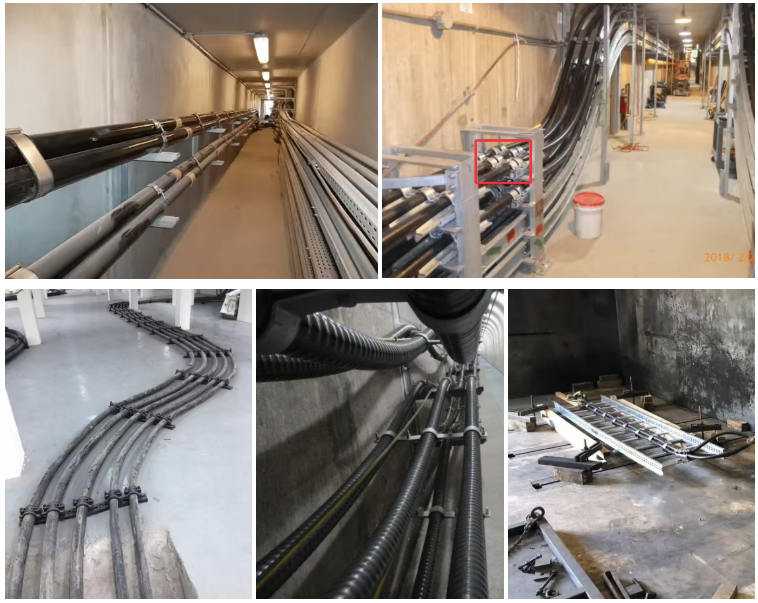
A cable cleat restrain cables during a 174kA short-circuit test (300mm spacing). Unrestrained cables moved violently, showing the critical role of cleating in electrical safety. The Ellis Patents cable clamps were used in conjunction with Vantrunk Speedway cable ladder containment.
Other factors include cable type, ratings, power system design, cable management/containment structure and installation environment – complete ranges of single cable clamps, trefoil cable clamps, quadrafoil cable clamps or bespoke engineered and designed to specific application requirement.
View below our complete range of Cable Clamps used to clamp and retain low, medium and high voltage cables in the event of a short circuit, including 11kV/33kV MV-HV power cables – single, trefoil, quadrofoil and multiple bundled cable configurations can be cleated using Ellis Patents and Prysmian manufactured electrical cable clamps in a choice of materials including nylon, stainless steel and aluminium.
Cable Cleats & Cable Clamps FAQs
What are Cable Cleats?
Cable cleats fix, clamp and support LV, MV and HV cables, providing short-circuit protection and preventing movement from fault currents. Correctly rated cleats ensure safe electrical installations by restraining cables under peak fault conditions. Available for all environments, cable cleats are vital for securing power systems in industrial, fire-resistant and offshore applications.
How to fix a Cable Cleat?
To install a cable cleat, position it at the recommended interval along the cable route, ensuring alignment with the cable diameter. Secure the cleat to a stable surface using approved fixings. Once in place, insert the cable and tighten the cleat to the manufacturer’s torque specification, ensuring firm restraint without damaging the cable insulation.
How to install a cable cleat:
✔ Position it at manufacturer-recommended intervals
✔ Align with the cable diameter
✔ Secure the cleat to a stable surface using approved fixings
✔ Insert the cable and tighten to the recommended torque—firm but not over-tight. This ensures effective restraint without damaging the cable.
What standards must cable cleats comply with?
Cable Cleats, Cable Clamps and Cable Hangers must be compliant with IEC 61914:2009, BS 7671:2008, and application-specific standards like LUL-085.