

How To Judge Whether A325 Bolts Need To Be Replaced?
Determining whether an A325 bolt needs replacement requires a comprehensive three-step approach: visual inspection, performance verification, and risk assessment, taking into account its appearance, mechanical properties, operating environment, and standard compliance. This approach focuses on the following seven key areas, covering a full range of scenarios from routine inspections to professional testing:
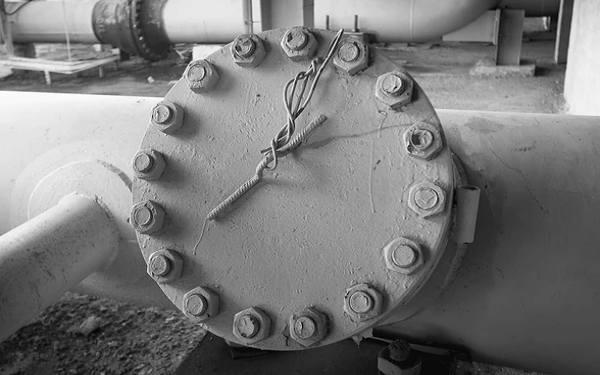
I. Appearance Damage: Irreversible physical defects warrant immediate replacement.
Appearance is the easiest visual indicator. Bolts with the following conditions require immediate replacement, as joint integrity cannot be guaranteed:
Broken shank/head: Regardless of the severity of the fracture (partial or complete), even if not completely detached, it can lead to a significant reduction in load-bearing capacity and pose a structural safety hazard.
Severe Thread Damage: Thread slippage (thread profile worn flat), deformation (thread crookedness), missing threads (partially missing threads), or thread insertion/ Visible sticking during disassembly prevents effective tightening with the nut.
Head damage: The hexagonal head is burred (worn edges prevent tool engagement), cracked (cracks at the junction of the head and shank), or deformed (e.g., flattened by a hammer), preventing effective torque application.
Washer failure: If the hardened washer that comes with the bolt is cracked, deformed (thickness compressed by more than 10%), or rusted and adhered (the washer cannot be separated from the bolt/connected part), it must be replaced along with the bolt. (The washer is a critical load-bearing component in the A325 joint; replacing it alone may result in uneven load distribution.)
II. Corrosion Extent: Replacement is indicated if the "repairable threshold" is exceeded.
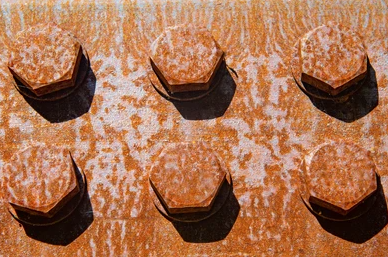
A325 bolts are mostly made of medium-carbon steel and are susceptible to environmental corrosion. Corrosion severity is determined based on the depth and extent of the corrosion:
Minor Corrosion: Only a small amount of surface rust appears (easily cleaned with a wire brush, with no noticeable pitting). Cleaning and reapplying with anti-rust paint suffices; no replacement is required.
Moderate Corrosion: Visible rust pits (≤0.1mm deep) appear on the surface, but the shank diameter has not decreased by more than 3% of the nominal diameter (e.g., an M20 bolt shank diameter not less than 19.4mm). Repair is possible through "rust removal and re-galvanizing/re-coating." After repair, torque retention testing is required. If acceptable, continued use is permitted.
Severe Corrosion: Rust pit depth >0.1mm, or the shank diameter has decreased by more than 3% of the nominal diameter, or the thread profile has become pointed due to corrosion (crest width reduced by >50%). This reduction in cross-section results in a reduction in tensile/shear strength exceeding 10% of the standard value, necessitating replacement.
Installation deviation: Long-term misalignment and stress exposure require replacement.
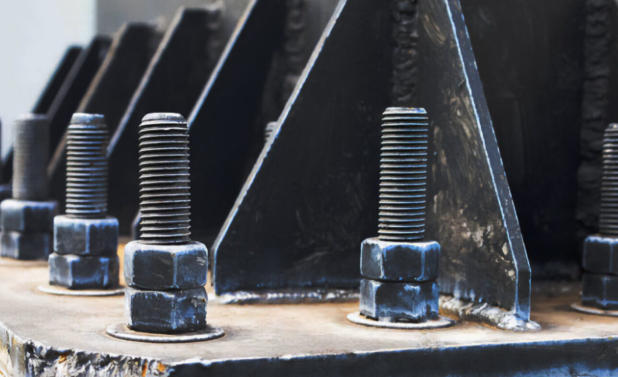
If installation deviation results in long-term non-axial stress on the bolt, fatigue damage will accelerate. This should be assessed based on age.
Bolt eccentricity: The bolt shank is not concentric with the bolt hole in the connected component (eccentricity > 1mm), resulting in combined bending and shear forces. If the bolt has been used for more than 5 years, or if bending of the bolt shank is observed (bend > 1°/100mm), replacement is recommended.
Overtightening: During installation, the torque exceeds the standard value by 15% (e.g., the standard torque is 250 ft-lb, but the actual torque is 300 ft-lb), causing plastic deformation of the bolt shank (measured with a caliper, the bolt shank diameter is at least 0.2mm thinner than the nominal diameter). Even if there is no obvious visual damage, replacement is necessary due to reduced yield strength.
Inappropriate length: The bolt is too short (less than 2 threads are exposed after being screwed into the nut) or too long (the bolt shank protrudes more than 10mm from the nut and has been subjected to long-term impact). If the connection is loose or the threads are worn, replace the bolt with a bolt of the appropriate length.